
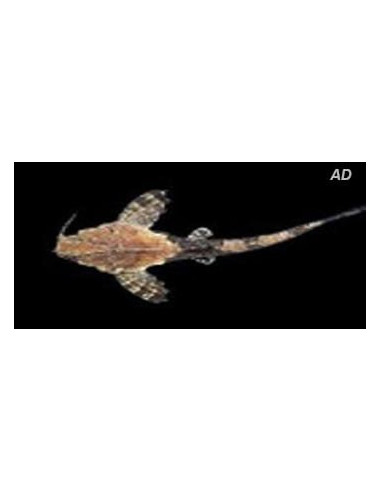
Bunocephalus Coracoideus 5-6cm Wild

Bunocephalus Coracoideus 5-6cm Wild

V1452500
€8.65
VAT included

Quantity Unit discount You Save
3 3% €0.78
5 5% €2.16
10 5% €4.33

redeem
By buying this product you can collect up to 8 loyalty points . Your cart will contain total 8 points that can be converted into a voucher of €0.16 .


Bunocephalus coracoideus 5-6cm Wild(Bunocephalus coracoideus)

Discreet wild banjo catfish for calm bottom aquariums

Bunocephalus coracoideus, commonly known as the banjo fish, is a highly original, perfectly camouflaged bottom-dwelling catfish that spends most of its time resting or half-buried in the substrate. The specimens shown here are wild cat fish measuring 5-6 cm, and should be kept in a mature, calm, well-oxygenated aquarium.

Origin & habitat

Bunocephalus coracoideus is native toSouth America, where it is found in several basins (including theAmazon) in calm rivers, backwaters, flooded areas and forest margins. It mainly frequents sandy-muddy bottoms covered in dead leaves, branches and plant debris, in waters that are generally mild to slightly acidic, poorly lit and rich in natural hiding places.

Description & sexual dimorphism

  • Sales size: 5-6 cm (wild specimens)
  • Adult size: up to around 10-12 cm
  • Lifespan: 5 to 8 years in good conditions
  • Body: flattened, irregular, reminiscent of a banjo or dead leaf.
  • Colouring: brown to mottled grey, with cryptic spots and patterns to aid camouflage
  • Head: broad, small, discreet eyes, sub-terminal mouth equipped with sensory barbels

Sexual dimorphism is not very marked. In adults, females are generally more plump, especially when full of eggs, while males have a slightly slimmer body.

Recommended water parameters

  • Temperature: 23-27°C
  • pH: 6.0-7.5 (slightly acidic to neutral)
  • Hardness: 2-15 °dGH (soft to moderately hard water)
  • Water quality: clean, well-oxygenated water, no nitrites, low nitrates

Banjo fish, especially wild fish, appreciate stable water with low levels of waste and gentle filtration with moderate stirring. Regular water changes (20-30% per week) are recommended.

Aquarium maintenance

  • Minimum recommended volume: 120 litres or more, with a good bottom surface.
  • Substrate: fine sand or a mixture of sand and mud that does not cut, allowing the fish to partially hide.
  • Decor: dead leaves, roots, branches, bark, hiding places (coconuts, tubes, caves)
  • Lighting: low to moderate, ideally subdued by floating plants
  • Filtration: effective but without strong currents at the bottom, preferably in calm areas

A decor rich in dark hiding places and leaf litter reproduces its natural biotope and greatly reduces stress. This is a fish that appreciates tanks that are not very agitated, with a calm open-water population.

Behaviour & cohabitation

Bunocephalus coracoideus is a crepuscular, nocturnal fish with a very peaceful temperament. During the day, it often remains motionless, resting on the bottom or partially buried, becoming more active as night falls.

  • Character: calm, non-aggressive, discreet; does not seek conflict.
  • Living zone: strictly the bottom of the tank.
  • Ideal mates: calm characids, small, peaceful dwarf cichlids, corydoras, small, non-aggressive loricarids.
  • Avoid: large cichlids, territorial or restless fish, large bottom predators.

It can cohabit with robust prawns and small fish, but very small or weak prey can be eaten opportunistically, especially at night.

Diet

An omnivore with carnivorous tendencies, the banjo fish feeds mainly onbenthic invertebrates and organic matter. In aquariums, care must be taken to ensure that the food reaches the bottom, especially in the presence of live fish in open water.

  • Bottom food: pellets, quality sinking granules for catfish.
  • Frozen/live: bloodworms (in moderation), artemia, fine krill, daphnia, various larvae.
  • Supplements: a variety of bottom foods, including a small plant-based component for overall balance.

Feeding at the end of the day or the very beginning of the night helps to respect the fish's natural rhythm and ensure it eats enough.

Reproduction in aquariums

Breeding Bunocephalus coracoideus in aquariums is a rare and tricky business, particularly with wild specimens. It is best reserved for experienced aquarists.

  • Tank type: calm aquarium with a fine substrate and plenty of hiding places.
  • Parameters: soft to slightly acidic water, very clean, temperatures in the upper range of the comfort zone.
  • A diet rich in living organisms and variations in temperature or water level can act as a trigger.
  • The eggs are deposited in hidden areas; the parents may not look after them.

Aquabota advice

  • Choose a well-stabilised tank with stable parameters and good oxygenation for these Wild fish.
  • Provide a soft substrate and plenty of dark hiding places to limit stress.
  • Feed them at twilight so that they can feed in peace.
  • Avoid overly lively or aggressive roommates, who could deprive them of food or cause stress.

Quick facts

  • Zoological Name: Bunocephalus coracoideus
  • Common name: banjo fish
  • Origin: South America (Amazon basin and tributaries)
  • Status: Wild
  • Purchase size: 5-6 cm
  • Adult size: around 10-12 cm
  • Swimming zone: bottom
  • Temperature: 23-27°C
  • pH: 6.0-7.5
  • Hardness: 2-15 °dGH
  • Behaviour: very peaceful, discreet, nocturnal
  • Difficulty level: intermediate (wild fish, calm and mature tank recommended)

Shipping & Delivery of live fish

Our Bunocephalus coracoideus Wild are prepared with the greatest care in our Aquabota fishroom. Each fish is selected, acclimatised and observed before shipping to ensure optimum health, which is particularly important for wild bottom feeders.

  • Packaging: oxygenated bags insulated in crates specially designed for transporting live fish.
  • Transport: express delivery via specially adapted carriers, to keep time spent in transit to a minimum.
  • Temperature: addition of heaters or ice packs depending on the season, to maintain a stable temperature.
  • Arrival: an Aquabota acclimatisation guide accompanies you step by step to help you introduce your fish in the best possible conditions.

If you have any questions before or after placing your order, our Aquabota team will be happy to advise you on compatibility with your population, the choice of decor and the ideal parameters for your Bunocephalus coracoideus.

categorie
Poissons tropicaux
origine
Capturés dans la nature
espece
Poissons-chats divers
nom latin
Bunocephalus Coracoideus 5-6cm Wild
Famille Biotope
Aspredinidé (Amérique du Sud)
Taille adulte
12–15 cm
Volume minimum du bac
150 L
Zone de vie
Fond
Comportement
Paisible
Régime alimentaire
Omnivore
Température
22–26 °C
pH
6.0–7.0
GH
2–8 °dGH
KH
1–5 °KH
Origine géographique
Brésil / Guyane
Reproduction
Ovipare
Espérance de vie
6–8 ans
Sexe
Mix
Niveau de difficulté
Intermédiaire
Compatibilité
Poissons calmes
DELIVERY OF LIVE ANIMALS – FRANCE EXPRESS

Delivery of live animals with France Express (mainland France, Belgium and Luxembourg)

When will my order be shipped?
We ship on Mondays and Tuesdays only. No shipments are made from Wednesday to Sunday inclusive.

Any order containing live animals must be placed before Monday at 10:00 am.
It will be shipped on Monday or Tuesday of the same week, depending on the destination.

How long will it take for my order to be delivered?
Delivery takes 24 hours (48 hours maximum) on weekdays.

No deliveries are made on weekends.

How will my order be shipped?
Via France Express, a carrier approved for the transport of animals.

Delivery is secure and the packaging is suitable (insulated boxes).
We add refrigerated packs in summer and heat packs in winter.

Where do you deliver?
Throughout mainland France, Belgium and Luxembourg.

Important: no deliveries will be made to pick-up points.

Do I need to be at home to receive the parcel?
Yes, you must be present.

You must be available at the specified time slot so that the delivery driver can hand-deliver the parcel.

Live animals are transported separately from other items. AquaBota is entitled to postpone a shipment in the event of adverse weather conditions.

You might also like

16 other products in the same category:

Product added to compare.