
Unavailable
Unavailable
Free delivery in Belgium and reduced shipping costs of €2.99 to France on orders over €59!

Free delivery in Belgium and reduced shipping costs of €2.99 to France on orders over €59!


Large algae-eating bottom catfish for spacious aquariums
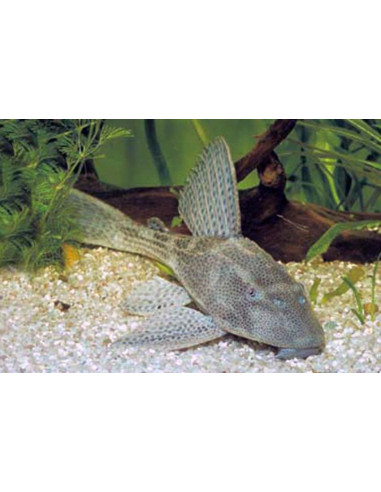
Hypostomus plecostomus, often referred to simply as the common pleco, is a large armoured loricariid catfish renowned for its appetite for algae and its robustness. Often sold young and small, it nevertheless reaches an imposing adult size and should be reserved for large aquariums.
Hypostomus plecostomus is native toSouth America (Amazon basin and other neighbouring river systems), where it inhabits rivers, tributaries and flooded areas with weak to moderate currents. It mainly frequents rocky or wooded bottoms, with roots, submerged trunks and numerous hiding places, in well-oxygenated water.
Sexual dimorphism is not very marked: in adults, males may have more developed odontodes (small spines) on the pectoral fins and along the body, while females are often rounder when viewed from above.
The common pleco is robust, but its adult size implies a high organic load: efficient filtration and regular water changes (30% per week) are essential.
Provide sturdy decorations (heavy roots, stable stones): an adult pleco can displace light elements by moving or sucking on them. Although it does graze on algae, it is no substitute for good maintenance.
Hypostomus plecostomus is a mainly nocturnal fish, peaceful but sometimes territorial towards its congeners or other large loricariids when it reaches adulthood.
An adult specimen in a small aquarium quickly becomes unsuitable: it produces a lot of waste, can uproot plants and stress the other occupants if there isn't enough space.
Hypostomus plecostomus is often mistakenly thought to eat only algae, but is in fact an omnivore with vegetarian tendencies.
A large pleco needs to be fed regularly: making do with the algae in the tank is insufficient and can lead to weight loss and opportunistic behaviour (attacks on vegetables, plants and even the mucus of other fish).
Reproduction of the common pleco in a pleasure aquarium is rare, mainly because of its adult size and the volumes required. In the wild, it is a cavity spawner:
In practice, reproduction tends to take place in very large tanks or specialised rearing facilities.
Our Hypostomus plecostomus are prepared with the greatest care in our Aquabota fishroom. Each fish is selected, acclimatised and observed before shipping to ensure optimum health.
If you have any questions before or after placing your order, our Aquabota team will be happy to advise you on compatibility with your population, the choice of decor and the ideal parameters for your Hypostomus plecostomus.
Specific References
When will my order be shipped?
We ship on Mondays and Tuesdays only. No shipments are made from Wednesday to Sunday inclusive.
Any order containing live animals must be placed before Monday at 10:00 am.
It will be shipped on Monday or Tuesday of the same week, depending on the destination.
How long will it take for my order to be delivered?
Delivery takes 24 hours (48 hours maximum) on weekdays.
No deliveries are made on weekends.
How will my order be shipped?
Via France Express, a carrier approved for the transport of animals.
Delivery is secure and the packaging is suitable (insulated boxes).
We add refrigerated packs in summer and heat packs in winter.
Where do you deliver?
Throughout mainland France, Belgium and Luxembourg.
Important: no deliveries will be made to pick-up points.
Do I need to be at home to receive the parcel?
Yes, you must be present.
You must be available at the specified time slot so that the delivery driver can hand-deliver the parcel.
Live animals are transported separately from other items. AquaBota is entitled to postpone a shipment in the event of adverse weather conditions.

Cumulez des points a chaque commande et transformez-les en bons de reduction.
Plus vous achetez, plus vous economisez.