
Unavailable
Unavailable
Free delivery in Belgium and reduced shipping costs of €2.99 to France on orders over €59!

Free delivery in Belgium and reduced shipping costs of €2.99 to France on orders over €59!


Wild twig catfish – very peaceful but sensitive bottom-dweller for mature, well-oxygenated aquariums
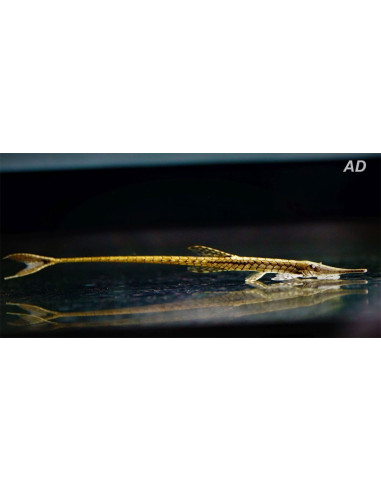
Farlowella acus 10–12 cm Wild (Farlowella acus), commonly known as the twig catfish or stick catfish, is a slender, highly specialised loricariid from South America. Our specimens are wild-caught and measure 10–12 cm; as adults they reach around 15–20 cm. This demanding species is part of our freshwater range and should be kept only in mature, stable, well-planted aquariums.
Farlowella acus is a very peaceful, shy and rather sedentary fish that spends most of its time attached to glass, roots or branches, mimicking a twig. It should not be combined with aggressive or boisterous tankmates that may harass it or outcompete it for food.
We recommend at least 120 litres (a long tank) for a small group, with a fully cycled filter, very clean, well-oxygenated water and minimal fluctuations. Avoid newly set-up aquariums. Use starter bacteria when cycling and monitor water values with our water tests. Perform regular but gentle water changes without sudden shifts in temperature or pH.
Farlowella acus is an aufwuchs and soft algae grazer with a mainly herbivorous diet. It feeds on soft algae, biofilm and plant material. In the aquarium, offer primarily vegetable-based wafers and tablets (spirulina, algae), supplemented with blanched vegetables (courgette/zucchini, cucumber, spinach, peas) and small amounts of protein-rich foods (finely chopped frozen foods such as brine shrimp or daphnia).
For best condition, vary the diet using our foods for herbivorous bottom fish. Feed close to the bottom and wood, preferably at dusk, so the Farlowella can feed without heavy competition.
Farlowella are quite sensitive to nitrite spikes and high nitrate levels. Before adding the fish, treat tap water with an appropriate water conditioner. Provide efficient but not overly turbulent filtration and maintain the tank with suitable maintenance tools and weekly water changes.
Set up the aquarium with a fine, smooth substrate and plenty of branchy wood, roots and elongated stones where the fish can rest and camouflage. Use lots of live plants (stem plants, Anubias, Microsorum) and optionally floating plants to soften the light.
A moderate lighting system, partially filtered by plants, will reduce stress and encourage a light growth of algae and biofilm for grazing. Add stable decorations without sharp edges.
| Scientific name | Farlowella acus |
|---|---|
| Adult size | 15 – 20 cm |
| Origin | South America (tributaries and calm zones of large river systems) |
| Temperature | 23 – 27 °C |
| pH | 6.0 – 7.5 |
| GH | 2 – 12 °dGH |
| KH | 1 – 6 °dKH |
| Conductivity | 50 – 250 µS |
| Life expectancy | 5 – 8 years (optimal conditions) |
| Behavior | Very peaceful, shy, best with gentle tankmates |
| Swimming zone | Bottom, glass and decor |
| Minimum volume | 120 L (small group) |
| Diet type | Herbivore/aufwuchs grazer (vegetable wafers, algae, fresh greens) |
Success with Farlowella acus Wild depends on a very stable, mature aquarium, excellent water quality and a mainly plant-based diet. Avoid noisy tankmates and fluctuating conditions.
Stability = success: check your parameters regularly with our water tests and perform small, regular weekly water changes.
Fish are shipped with great care in insulated, purpose-designed packaging to ensure their safety during transport.
Specific References
When will my order be shipped?
We ship on Mondays and Tuesdays only. No shipments are made from Wednesday to Sunday inclusive.
Any order containing live animals must be placed before Monday at 10:00 am.
It will be shipped on Monday or Tuesday of the same week, depending on the destination.
How long will it take for my order to be delivered?
Delivery takes 24 hours (48 hours maximum) on weekdays.
No deliveries are made on weekends.
How will my order be shipped?
Via France Express, a carrier approved for the transport of animals.
Delivery is secure and the packaging is suitable (insulated boxes).
We add refrigerated packs in summer and heat packs in winter.
Where do you deliver?
Throughout mainland France, Belgium and Luxembourg.
Important: no deliveries will be made to pick-up points.
Do I need to be at home to receive the parcel?
Yes, you must be present.
You must be available at the specified time slot so that the delivery driver can hand-deliver the parcel.
Live animals are transported separately from other items. AquaBota is entitled to postpone a shipment in the event of adverse weather conditions.

Cumulez des points a chaque commande et transformez-les en bons de reduction.
Plus vous achetez, plus vous economisez.